
While hearing the matter on December 1, the top court had observed that once posters or signages are pasted outside the homes of COVID patients, the people affected are treated as "untouchables", reflecting a different "ground reality".
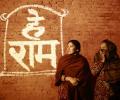
The senior advocate had on Tuesday told the court that the birth place of Lord Ram is also a deity and Muslims cannot claim right over the 2.77-acre disputed land in Ayodhya as any division of the property would amount to "destruction" and "mutilation" of the deity itself.

A PIL has been filed in the Supreme Court seeking a direction to the Centre to cancel licences and not to grant new ones to Indian firms exporting arms and other military equipment to Israel, which is fighting a war in Gaza.
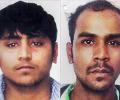
Nirbhaya's mother Asha Devi said even the court understands that the convicts are filing pleas one after the other just to delay the hanging.

In the ongoing hearing of the matter related to the constitutional validity of linking Aadhaar card to a number of government schemes, Divan who is appearing for the petitioners, said that a people's constitution was being converted into a state's Constitution and it was incorrect to take people's biometric data for Aadhaar.

Attorney General K K Venugopal had granted consent for initiation of criminal contempt proceedings against Kamra, saying the tweets were in "bad taste".

Justice Ranjan Gogoi, who will demit office as the Chief Justice of India in a week's time, has etched his name in the annals of history by giving finality to one of the most politically and religiously sensitive cases, the Ayodhya land dispute, which dates back to even before the Supreme Court came into existence in 1950.
The apex court will pronounce the judgement at 10.30 am on Saturday.

"The Right to Life as guaranteed by Article 21...gives the right to every human being to live a life of dignity with access to at-least bare necessities of life. To provide food security to impoverished persons is the bounden duty of all States and Governments," the top court observed while issuing a slew of directions on a plea of three activists.

The judges -- Chief Justice Ranjan Gogoi, CJI-designate Sharad Arvind Bobde and justices Dhananjaya Y Chandrachud, Ashok Bhushan and S Abdul Nazeer -- delivered the verdict in the century-old dispute.
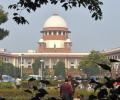
The Supreme Court on Wednesday asked Maharashtra Police to place on record the second supplementary charge sheet filed in the case related to alleged lynching of three people, including two seers, in Palghar district in April last year.

One of the most important cases which have political implications is the Ayodhya land dispute case.

The apex court said the Constitution Bench would commence final hearing from January 17 on the petition challenging the Aadhaar scheme itself.

None of the four judges -- Justices J Chelameswar, Ranjan Gogoi, M B Lokur and Kurian Joseph -- feature in the list of members of the 5-judge constitution bench.
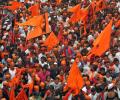
The judgment came on a batch of pleas challenging the Bombay high court verdict which had upheld the grant of reservation to Marathas in admissions and government jobs in the state.
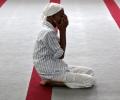
The issue had cropped up when a three-judge bench headed by Chief Justice Dipak Misra was hearing the batch of appeals filed against the Allahabad high court's 2010 verdict by which the disputed land on the Ram Janmabhoomi-Babri Masjid area was divided in three parts.

The judges on the bench are CJI S A Bobde, Justices R Banumathi, Ashok Bhushan, L Nageswara Rao, M M Shantanagoudar, S A Nazeer, R Subhash Reddy, B R Gavai and Surya Kant.

The government said this before a bench headed by Justice Ashok Bhushan which reserved order on a plea seeking directions to do away with the practice of pasting posters outside the homes of those infected by coronavirus.

'Applications seeking permission to file review petitions are allowed. We have carefully gone through the review petitions and the connected papers. We find no merit in the review petitions and the same are accordingly dismissed,' the bench said in its order.

A court on Sunday ordered the release of protesters on certain conditions, including production of personal surety of Rs 7,000 and assurance that they would not take part in protests.

The mercy petitions of three convicts -- Mukesh, Vinay and Akshay -- have already been dismissed by the President.
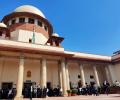
A bench comprising Chief Justice DY Chandrachud and Justices JB Pardiwala and Manoj Misra said Indian firms, involved in the export of arms and equipment to Israel, may be sued for breach of contractual obligations if they are stopped by it from supplying.

A bench comprising Chief Justice Dipak Misra and justices R Banumathi and Ashok Bhushan is expected to deliver its judgment on the pleas of Mukesh, 29, Pawan Gupta, 22, and Vinay Sharma, 23.

The West Bengal government has challenged the provision which said that without Aadhaar, the benefits of social welfare schemes would not be extended.

The important observation on the interpretation of the provision came in a judgement by which the top court directed National Disaster Management Authority to issue guidelines in six weeks for ex gratia compensation to families of those who died of Covid.
The apex court had on May 5, 2017 upheld the verdict of the Delhi high court and the trial court awarding capital punishment to four convicts - Mukesh, 29, Pawan Gupta, 22, Vinay Sharma, 23, and Akshay Kumar Singh, 31, -- in the sensational December 2012 case that related to gang rape and murder of a 23-year-old paramedic student in Delhi.

The newly elected Congress legislators, who are staying at a resort on the city outskirts, also joined the protest.
Rai claimed he has been framed in the case as he has been writing against an Enforcement Directorate official who was part of the team probing the 2G spectrum allocation scam case.

A bench of Justices Ashok Bhushan and K M Joseph took this decision while hearing an application filed by the Board of Control for Cricket in India (BCCI).
In view of the differences, Justices A K Sikri and Ashok Bhushan referred the matter to a larger bench of the apex court.

Testing only those with symptoms is not such a great idea. A lot of asymptomatic people are also positive. Its also important to do some amount of random testing in the clusters. You need to do lot more testing. The more you test, the more positives you get. Only redeeming feature is that the number of those getting into ICU or dying is not huge, she said.
For how many generations would reservations in jobs and education continue, the Supreme Court sought to know during the Maratha quota case hearing on Friday and raised concerns over 'resultant inequality' in case the overall 50 per cent limit was to be removed.

The Supreme Court on Tuesday sought response from the four death row convicts in the Nirbhaya gang rape and murder case on the Centre's appeal challenging the Delhi high court verdict which dismissed its plea against stay on their execution.

A bench of Justices Ashok Bhushan, S K Kaul and M R Shah said that 'with regard to this incident, this court has already taken cognisance. There is no question of multiplying the petitions one by one'.

The observations by a bench headed by Justice Ashok Bhushan came after the Centre apprised it that ongoing wave of the pandemic appears to be 'harsher' than earlier.
The petition sought recording of calls, documents and reports by an investigating agency like CBI and to declare that the convict has legal and constitutional rights to approach any court at any time even in the last minute of hanging.

The petitioner contended that the provisions in the notification were unconstitutional.

The apex court had last year disallowed Swamy from intervening in the Ayodhya land dispute case.

The apex court, which dismissed the review pleas filed by three of the four death row convicts of the sensational December 16, 2012 Nirbhaya gangrape and murder case, said the courts cannot be held for committing any illegality in awarding capital punishment in "appropriate cases" till death penalty remains in the penal code.

"If the states are not complying with the directions and orders of the Central government, you are not helpless. You have to ensure that your order is implemented. "You have got the power under the Disaster Management Act. You can take steps also," the bench told Solicitor General Tushar Mehta, appearing for the Centre.
